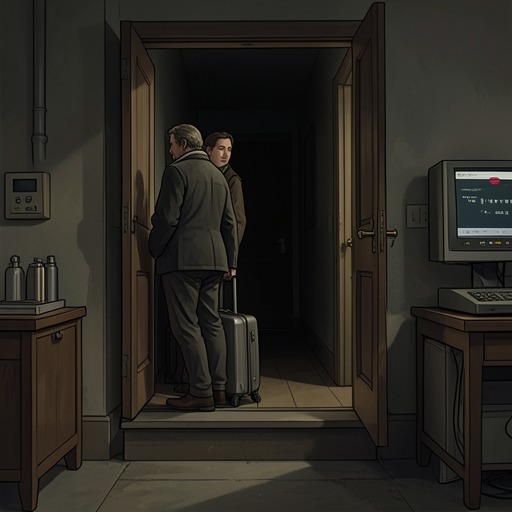
Dolphin Cottage
The LighthouseDolphin Cottage, just north-west of the lighthouse on Combe Island, is the home of Guy Staveley and his wife, Joanna. Its importance lies not in its size or furnishings, which the narrative does not detail, but in the private life enclosed by its stone walls: a marriage that offers Guy comfort while leaving him uncertain of what it means to Joanna, and a household whose routines become relevant when the island is shaken by Nathan Oliver’s death.
Setting and Occupants
Rupert Maycroft’s map places Dolphin Cottage at the island’s south-western end, just north-west of the lighthouse. Guy and Joanna live there together. Joanna is a nurse, and both spouses helped care for Martha Padgett before her death. The cottage is thus a home as well as part of the island’s small network of practical care, where the residents’ domestic and professional lives overlap.
The surrounding weather gives the setting its clearest physical presence. On one stormy night, booms like distant gunfire sound outside the cottage, and the logs in its fireplace flare into life. Guy has disliked such nights when Joanna was away in London: the wind’s moaning and howling seemed too like a human lament, intensifying his sense of deprivation. With her at home, the same violence outside the stone walls becomes reassuring, emphasizing the comfort and security within. After midnight the storm subsides, and Combe Island lies calm beneath emerging stars. The change in weather makes the cottage’s protective quality emotional as well as physical, without making Guy’s security in the marriage equally certain.
Marriage and Domestic Life
Joanna has been back on Combe Island for four weeks when the couple’s private routine comes into view. She returns as if she had never been away and as if theirs were an ordinary marriage. Guy, who fell in love with her at their first meeting and believes himself incapable of changing, is devoted to her; he thinks there will never be another woman for him. He also understands that her feelings have different limits. Before their marriage, she told him she loved him but was not in love, and that she wanted a quiet life with someone she respected and cared for. Guy accepted that arrangement then and continues to accept it, though the disparity between their attachments remains palpable.
The cottage’s bedroom sharpens that contrast through small, specific habits. After lovemaking, Joanna sits cross-legged on a twin bed in a pink satin dressing gown, drawing it carefully over her nakedness with what Guy regards as the modesty of a Victorian bride. He finds this incongruous with her usual provocative manner, which he describes as sometimes shameless and apparently unaware of its effect, and regards the contradiction as endearing even after twenty years of marriage. He wishes they shared a double bed so that he could reach her and communicate his gratitude for her generous, unquestioning sexuality. The wish is for physical closeness, but it also exposes how much he longs to make their understanding of the marriage coincide.
Joanna’s absences leave questions that the homecoming does not resolve. When she is in London, she works, including part-time in the accident and emergency department at St. Jude’s, and speaks of social activities such as parties, plays, concerts, and restaurants. Guy wonders whom she sees and whether anyone accompanies her home, but fears asking what he wants to know. The narrative locates this uncertainty within their life at Dolphin Cottage: her return restores familiar domestic habits, while his need to know remains unspoken. The cottage shelters their life together without erasing the separate terms on which they experience it.
Work, Guilt, and Island Routine
Conversation at home also brings Guy’s medical work and its unresolved burden into the marriage. Joanna reports that the London practice where he previously worked wants him back; its doctors have not advertised for a replacement, and his former patients have been asking for him. She adds that the controversy around Winston Collins has faded and that the boy’s family has left the district. Guy resists reducing Winston to a past controversy. He remembers him as a boy with an awful life and a strikingly happy grin, and insists on the seriousness of his own failure: Winston died of peritonitis, and Guy believes he should have gone when the child’s mother called. For him, the rule never to take chances with a child is not an abstraction but a measure of professional responsibility he feels he breached.
Joanna questions whether remaining on Combe Island is work worthy of Guy’s ability. She points to the limited demands of island practice: Nathan Oliver’s hypochondria, the possibility of one of Jago Tamlyn’s climbing novices falling from a cliff, and the fact that Emily Holcombe is rarely ill while visitors generally arrive in good health. Guy answers that it is the only work he currently feels able to manage. Joanna, meanwhile, describes her own part-time nursing in London, including the pressure of a busy emergency department and her concern about recruiting medical staff from countries that need them more. Their exchange shows the cottage as a place where island life and mainland work are weighed against each other, and where Guy’s choice to stay is bound up with the limits he feels in himself.
The Investigation and the Cottage Alibi
After Nathan Oliver’s blood sample is accidentally dropped overboard at the harbour by Dan Padgett, Joanna tells Guy that Oliver is due to provide another sample at nine the following morning. She expects the appointment to be difficult because he hates needles, though she is confident in her ability to find a vein. This routine medical business places the couple’s work within the investigation’s timetable and precedes Oliver’s failure to arrive.
When questioned after Oliver’s death, Joanna gives a precise account of the night. She says she and Guy attended dinner, stayed for coffee in the library, and then returned to Dolphin Cottage. According to her, they remained there together until going to bed just before eleven; neither left the cottage. They breakfasted there on grapefruit, toast, and coffee. Joanna then went to the surgery to wait for Oliver, who was expected at nine. When he had not arrived by nine-twenty, she began calling around to find out what had delayed him. She says that Guy joined the search and that she learned what had happened only when he returned to tell her. Her account makes the cottage an important point in the chronology, though she acknowledges that there had been time to fabricate an alibi before the investigators arrived.
The cottage consequently carries two meanings through the investigation. It is the place where Guy experiences refuge from the storm and maintains the routines of marriage, but it is also the location on which the couple’s account of their movements depends. The comfort it affords is genuine, yet it cannot settle either the emotional uncertainties between its occupants or the questions raised by Oliver’s death.